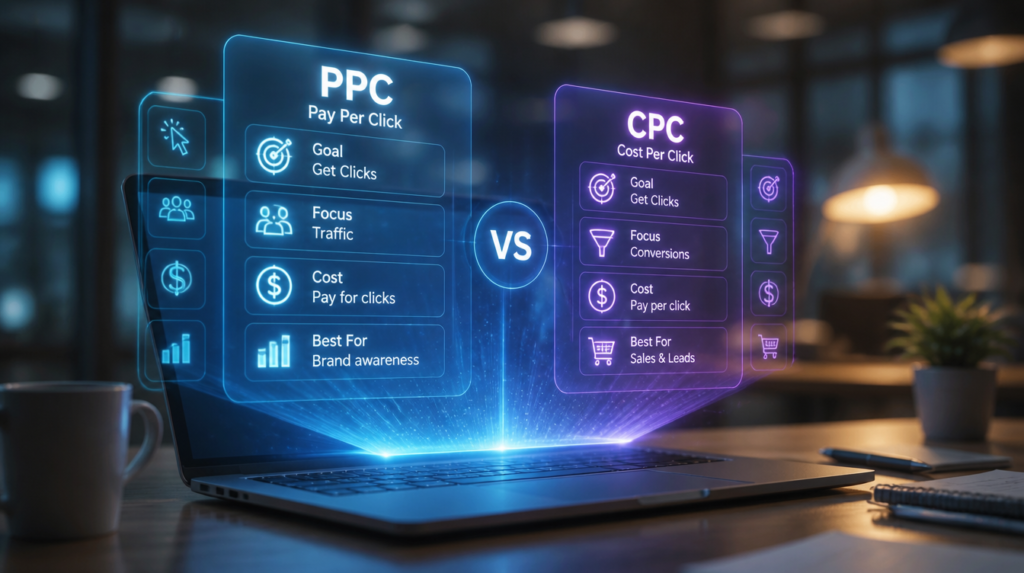
Quick answer: In the PPC vs CPC comparison, PPC (pay-per-click) is the advertising model where you pay each time someone clicks your ad. CPC (cost-per-click) is the metric – the actual amount you pay for each click. Put simply: PPC is the system you run; CPC is the price you pay within it.
What does PPC mean?
PPC stands for pay-per-click. It’s an advertising model in which you only pay when someone actually clicks your ad – not when it’s shown. Display the ad to a thousand people, and if nobody clicks, you pay nothing.
PPC is the engine behind Google Ads, Microsoft Ads, and the paid ads you see across Meta, LinkedIn, and similar platforms. When people say “we’re running PPC,” they mean they’re running a paid advertising campaign on a pay-per-click basis. The ppc meaning, then, is the whole approach: keywords, ad copy, bids, targeting, and budgets, all working together.
A typical PPC campaign involves:
- Choosing keywords or audiences to target
- Writing ads
- Setting bids and budgets
- Sending clicks to a landing page
- Measuring and optimising results
What does CPC mean?
CPC stands for cost-per-click. It’s a metric – the actual price you pay each time someone clicks your ad. If you spend 1,000 rupees and get 50 clicks, your CPC is 20 rupees.
So the cpc meaning is simply: how much each click costs you. It’s one of the most-watched numbers in any paid campaign because it directly affects how far your budget stretches. Lower CPC means more clicks for the same money; higher CPC means fewer.
CPC is determined by an auction. The platform weighs your bid against competitors’ bids and the quality of your ad to decide what you actually pay per click – often less than your maximum bid.
PPC vs CPC: the key difference at a glance
The simplest way to remember it: PPC is the model, CPC is the metric. You run a PPC campaign, and you measure its cost in CPC. Here’s a side-by-side comparison.
| Aspect | PPC (Pay-Per-Click) | CPC (Cost-Per-Click) |
|---|---|---|
| What it is | An advertising model / method | A pricing metric |
| What it answers | “How do I advertise?” | “How much does each click cost?” |
| Type | A strategy you run | A number you measure |
| Example | “We run PPC on Google Ads” | “Our CPC is 25 rupees” |
| Used for | Planning and running campaigns | Measuring and managing cost |
| Relationship | The system that contains CPC | A metric inside the PPC system |
So when someone asks about the difference between PPC and CPC, the cleanest answer is: PPC is what you’re doing, CPC is what it costs you to do it.
How do PPC and CPC work together?
These two aren’t rivals – they’re partners. You can’t have a CPC without a PPC campaign, and you can’t run a PPC campaign without paying some CPC. Think of it like driving: PPC is the act of driving your car, and CPC is the price of fuel per kilometre. You’re always doing both at once.
In a real Google Ads campaign, this connection plays out constantly. You set up the PPC campaign (the model), and the platform charges you a CPC (the metric) for each click. Your job – or your agency’s – is to run the PPC side well so the CPC side stays efficient.
Here’s a concrete example. Imagine you launch a PPC campaign with a 1,000 rupee daily budget. Over a day, 40 people click your ads. That means your CPC averaged 25 rupees. The next week you improve your ad copy and landing page, your Quality Score rises, and suddenly the same 1,000 rupees buys 50 clicks – a CPC of 20 rupees. You didn’t change the model (still PPC); you simply ran it better, and your CPC dropped. That’s the whole relationship in a nutshell.
Are there other “CP” metrics to know?
CPC is part of a small family of advertising metrics, and it helps to know the neighbours so you don’t mix them up:
- CPM (cost per mille) – the cost per 1,000 ad impressions, used when you’re paying for visibility rather than clicks.
- CPA (cost per acquisition) – the cost to get one conversion, like a lead or a sale.
- CPL (cost per lead) – a more specific version of CPA focused on leads.
- CPC (cost per click) – the cost of a single click, the one we’re focused on here.
All of these can exist inside a PPC campaign. The model stays “pay-per-click,” but you measure success through whichever metric matters most for your goals. For a lead-gen business, CPC tells you click cost while CPL or CPA tells you what a customer actually costs – both useful, neither replacing the other.
Why does the difference matter for your budget?
Understanding both terms helps you make better decisions and ask better questions:
- When planning, you think in PPC terms: which platform, which keywords, which audiences, what message.
- When measuring, you watch CPC to see if your budget is being spent efficiently.
- When optimising, you adjust the PPC campaign (better ads, tighter targeting, stronger landing pages) to bring your CPC down.
A business owner who knows the difference won’t be confused when an agency says “we lowered your CPC by improving your PPC structure.” They’ll understand exactly what happened: the campaign got better, so each click got cheaper.
What affects your CPC within a PPC campaign?
Since CPC determines how far your PPC budget goes, it’s worth knowing what moves it:
- Competition. More advertisers bidding on a keyword pushes CPC up.
- Quality Score. Relevant ads and good landing pages earn lower CPCs from Google.
- Industry. High-value sectors like finance and law have far higher CPCs than retail.
- Keyword choice. Broad, popular keywords cost more than specific long-tail ones.
- Targeting. Location, device, and timing all influence what you pay.
Common mistakes and misunderstandings
A few things trip people up when they’re learning the difference between ppc and cpc:
- Using the terms interchangeably. They’re related but not the same. Saying “increase my CPC” when you mean “improve my PPC campaign” leads to confusion.
- Chasing the lowest CPC. A cheap click is worthless if it never converts. A 10-rupee click that never buys is more expensive than a 50-rupee click that does.
- Forgetting other metrics. CPC is one number among many. Conversion rate, cost per conversion, and ROAS tell you whether your PPC is actually working.
- Thinking lower CPC always means better. Sometimes paying more per click for high-intent searchers delivers far better returns.
Another subtle trap is judging campaigns in isolation. A high CPC on a single keyword might look alarming, but if that keyword brings in your most valuable customers, it could be your best-performing line item. Conversely, a rock-bottom CPC on a keyword that never converts is pure waste dressed up as efficiency. Always read CPC in the context of what each click is actually worth to your business – the number alone never tells the full story.
Quick tips to keep both in check
- Optimise your PPC structure (ad relevance, landing pages) to naturally lower CPC.
- Judge success by cost per conversion, not just CPC.
- Use negative keywords to stop paying for irrelevant clicks.
- Test ad copy and landing pages regularly – small improvements compound.
- Track conversions so you know which clicks are actually worth the cost.
Putting it all together
The PPC vs CPC distinction is simple once it clicks: PPC is the advertising model you run, and CPC is the price you pay per click within it. One is the system, the other is the metric. Knowing both helps you plan smarter campaigns and ask sharper questions of whoever manages your ads – and it stops you from being misled by jargon when you compare quotes or read a performance report.
Book a free 30-minute strategy call with Market IQ Consulting. We’ll explain how your PPC campaigns and CPC stack up, and show you where you can get more clicks and conversions for less – no pitch decks, no hard sell.
Key takeaways
- PPC is an advertising model; CPC is a pricing metric within that model.
- You run a PPC campaign, and you measure (and pay) its cost in CPC.
- Lower CPC means cheaper clicks, but conversions matter more than cheap clicks.
- The terms are related, not competing – you can’t talk about one without the other.
If you’ve spent any time around digital advertising, you’ve seen “PPC” and “CPC” used almost interchangeably – and it’s genuinely confusing. They sound similar, they appear in the same conversations, and plenty of people mix them up. But they mean different things, and understanding the difference makes you a smarter advertiser. This guide clears it up in plain language.
Frequently asked questions
Is PPC the same as CPC?
No. PPC (pay-per-click) is the advertising model where you pay for clicks. CPC (cost-per-click) is the metric showing how much each click costs. PPC is the system you run; CPC is the price you pay within it.
What does CPC stand for?
CPC stands for cost-per-click – the actual amount you pay each time someone clicks your ad. If you spend 1,000 rupees for 50 clicks, your CPC is 20 rupees per click.
What does PPC stand for?
PPC stands for pay-per-click, an advertising model in which you only pay when someone clicks your ad rather than when it’s shown. Google Ads and most paid social ads use the PPC model.
Which is more important, PPC or CPC?
Neither is more important – they work together. You run a PPC campaign and measure its efficiency with CPC. Both matter, but ultimately conversions and cost per conversion show whether your PPC is profitable.
How do I lower my CPC?
Improve your Quality Score with relevant ads and landing pages, add negative keywords, focus on specific long-tail keywords, and tighten your targeting. Better PPC campaign structure naturally lowers your CPC.
Is a low CPC always good?
Not necessarily. A low CPC is only valuable if those clicks convert. A cheap click that never becomes a customer is more expensive than a costlier click that does. Always weigh CPC against conversions.