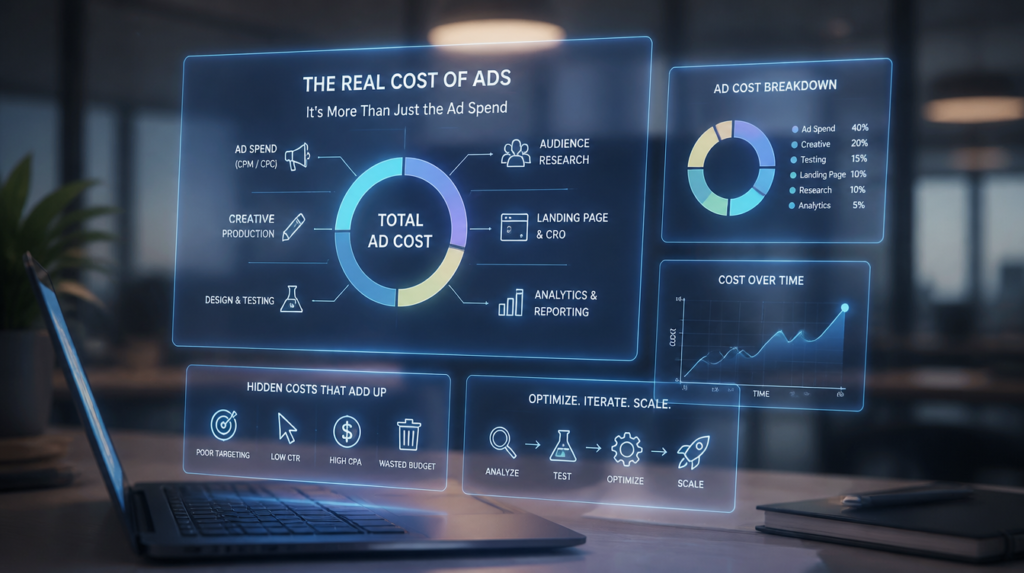
Quick answer: How much Google Ads cost depends on your industry, keywords, and competition. Most small and mid-sized businesses spend between Rs 30,000 and Rs 3,00,000 per month on ad spend, with cost per click ranging from a few rupees to a few hundred. Your total budget is simply CPC multiplied by clicks, plus any management fee.
So how much do Google Ads actually cost?
There’s no sticker price for Google Ads, and that trips up a lot of business owners. Google runs an auction: you set a budget, you bid on keywords, and you pay only when someone clicks your ad. That means you’re never locked into a fixed monthly fee for the platform itself – you decide how much to spend.
What that spend buys, though, depends on three things: how competitive your keywords are, how relevant your ads and landing pages are, and how much your competitors are willing to pay. Put those together and you get your cost per click – the single number that drives your whole budget.
So when someone asks “how much do Google Ads cost,” the honest answer is: as much as you choose, but how far that money goes depends on your market. Let’s break it down properly.
What is cost per click and why does it vary so much?
Cost per click (CPC) is the amount you pay each time someone clicks your ad. It’s set by an auction every time a search happens, and it’s shaped by a few factors:
- Competition. The more advertisers bidding on a keyword, the higher the price.
- Keyword intent. “Buy” and “hire” keywords cost more than informational ones because they signal a ready buyer.
- Quality Score. Google rewards relevant ads and good landing pages with lower CPCs.
- Location and device. Metro cities and certain devices can carry higher costs.
- Industry. A click for legal services costs far more than one for a local bakery.
This is why two businesses can run “the same” campaign and see wildly different bills. A well-structured account with a strong Quality Score can pay noticeably less per click than a sloppy one bidding on the same words.
What is the typical CPC by industry?
Below are realistic, typical CPC ranges you can expect on Google Search in the Indian market. These are broad averages – your actual numbers depend on your keywords, location, and competition – but they’re useful for planning.
| Industry | Typical CPC range (Search) | Notes |
|---|---|---|
| Legal & financial services | Rs 80 – Rs 400+ | High value, fierce competition |
| Insurance | Rs 60 – Rs 300 | Very competitive nationally |
| Real estate | Rs 30 – Rs 150 | Varies sharply by city |
| Healthcare & clinics | Rs 25 – Rs 120 | Local intent keeps it moderate |
| B2B / SaaS | Rs 50 – Rs 250 | Niche keywords, smaller volume |
| E-commerce & retail | Rs 5 – Rs 60 | High volume, lower per-click |
| Education & coaching | Rs 20 – Rs 120 | Seasonal spikes around admissions |
| Local services (plumbing, salons) | Rs 10 – Rs 80 | Geo-targeted, often affordable |
Notice the spread. An e-commerce store might pay Rs 15 a click, while a law firm pays Rs 300 for a single one. Neither is “expensive” or “cheap” on its own – what matters is whether that click turns into a customer worth more than it cost.
How is a Google Ads budget actually built?
Here’s the simple formula that demystifies your whole google ads budget:
Ad spend = average CPC x number of clicks you want
Say your average CPC is Rs 50 and you want 1,000 clicks a month. Your ad spend is Rs 50,000. Want more clicks or to compete for pricier keywords? The number rises. It really is that direct.
To work backwards from goals instead:
- Set a target. How many leads or sales do you need this month?
- Estimate conversion rate. If 5% of clicks convert, you need 20 clicks per lead.
- Multiply by CPC. 20 clicks x Rs 50 = Rs 1,000 per lead.
- Scale to your target. Need 50 leads? That’s roughly Rs 50,000 in ad spend.
This approach turns a vague “how much do Google Ads cost” into a number tied to actual business outcomes. Our Google Ads management team builds budgets this way so spend always maps to results, not guesswork.
What about management fees?
If you hire an agency or freelancer, there’s a second cost on top of ad spend: management. This pays for strategy, keyword research, ad writing, bid optimisation, and reporting. Common structures include:
- Percentage of ad spend – often 10-20%, suited to larger budgets.
- Flat monthly retainer – a fixed fee, typically Rs 15,000-Rs 50,000+ for SMBs.
- Performance-based – tied to leads or revenue, less common and easy to misuse.
So your real total is: ad spend + management fee. A business spending Rs 1,00,000 on clicks might pay another Rs 15,000-Rs 20,000 for expert management. That fee usually pays for itself by lowering CPC and lifting conversion rates – a well-run account wastes far less.
What is a realistic Google Ads budget to start with?
For a small business testing the waters, Rs 30,000-Rs 50,000 a month in ad spend is usually enough to gather meaningful data in most local markets. Mid-sized businesses competing in tougher categories often run Rs 1,00,000-Rs 3,00,000+. The goal early on isn’t to win – it’s to learn which keywords and ads convert, then scale the winners.
Spending too little is a common trap: a Rs 5,000 budget in a Rs 200-CPC industry buys just 25 clicks, far too few to learn anything. Match your budget to your market, or pick cheaper, lower-competition keywords to start.
Do different campaign types cost different amounts?
Yes – and this matters when you plan a budget. “Google Ads” isn’t one thing; it’s several campaign types, each with its own cost behaviour:
- Search campaigns carry the highest CPCs because intent is high, but they often convert best.
- Display campaigns have far lower CPCs (sometimes a few rupees) since they reach people who aren’t actively searching.
- Shopping campaigns suit e-commerce and price per click on product visibility, often cheaper than search.
- Video (YouTube) campaigns can use cost-per-view, sometimes well under a rupee per view.
- Performance Max blends placements automatically, so costs vary with where it serves.
A common smart approach is to split budget: search to capture ready buyers, plus a smaller display or video budget for cheaper awareness and retargeting. Mixing campaign types lets you balance high-intent results with low-cost reach, stretching the same budget further. The right split depends on your goal – lead generation usually leans heavily on search, while a brand launch might justify more spend on video and display to build awareness fast.
Common mistakes that inflate your Google Ads cost
Plenty of advertisers pay more than they should. Avoid these:
- Ignoring negative keywords. Without them, you pay for irrelevant clicks that never convert.
- Sending traffic to a weak landing page. A poor page drops conversion rates and forces you to buy more clicks per lead.
- Targeting too broadly. Bidding on vague, high-volume terms burns budget fast.
- Skipping conversion tracking. If you can’t see what drives leads, you can’t cut what doesn’t.
- Setting and forgetting. CPCs and competition shift; accounts need regular tuning.
Each of these quietly raises your effective cost per lead – sometimes far more than the headline CPC suggests. Fixing them is often cheaper than raising your budget.
Tips to get more from every rupee
- Focus on high-intent keywords where buyers are ready to act.
- Improve Quality Score with tight ad groups and relevant landing pages.
- Use location and schedule targeting to avoid wasted impressions.
- Test ad copy continuously and keep the winners.
- Track conversions, not just clicks, so you optimise for outcomes.
Done well, these moves can cut your cost per lead substantially without raising your budget at all.
Plan your Google Ads budget with confidence
The real question isn’t just how much Google Ads cost – it’s how much value each click brings back. With the right keywords, a sharp account structure, and proper tracking, even a modest budget can deliver a steady stream of leads.
Book a free 30-minute strategy call with Market IQ Consulting. We’ll estimate realistic CPCs for your industry, build a budget tied to your goals, and show you where you can spend smarter – no pitch decks, no hard sell.
Key takeaways
- Google Ads has no fixed price – you control the budget and pay per click.
- Cost per click varies hugely by industry, from a few rupees to several hundred.
- Total cost = average CPC x clicks needed, plus a management fee if you hire help.
- High-intent, competitive keywords cost more but often convert better.
- A clear goal and conversion tracking matter more than the size of your budget.
Frequently asked questions
How much do Google Ads cost per month?
Most small and mid-sized businesses spend between Rs 30,000 and Rs 3,00,000 per month on ad spend, depending on industry and goals. There’s no minimum platform fee – you set the budget. Add a management fee if you work with an agency or specialist.
What is a good cost per click for Google Ads?
A “good” CPC is one that returns more value than it costs. CPCs range from a few rupees in e-commerce to several hundred in legal or financial services. Focus on cost per lead and return on ad spend rather than CPC alone.
Can I run Google Ads on a small budget?
Yes, but match your budget to your market. In low-CPC, local categories, Rs 30,000 a month can work well. In high-CPC industries, a tiny budget buys too few clicks to learn from, so target cheaper keywords first.
Why are my Google Ads so expensive?
High costs usually come from competitive keywords, a low Quality Score, broad targeting, or weak landing pages. Adding negative keywords, tightening ad groups, and improving relevance can lower your CPC and your cost per lead noticeably.
How do agencies charge for Google Ads management?
Common models are a percentage of ad spend (often 10-20%), a flat monthly retainer (typically Rs 15,000-Rs 50,000+ for SMBs), or performance-based fees. This is separate from your ad spend and covers strategy, optimisation, and reporting.
Do Google Ads work for small businesses in India?
Yes. With local targeting, high-intent keywords, and a clear offer, Google Ads can deliver qualified leads quickly for small businesses. The key is tracking conversions and optimising regularly so spend stays tied to real results.